
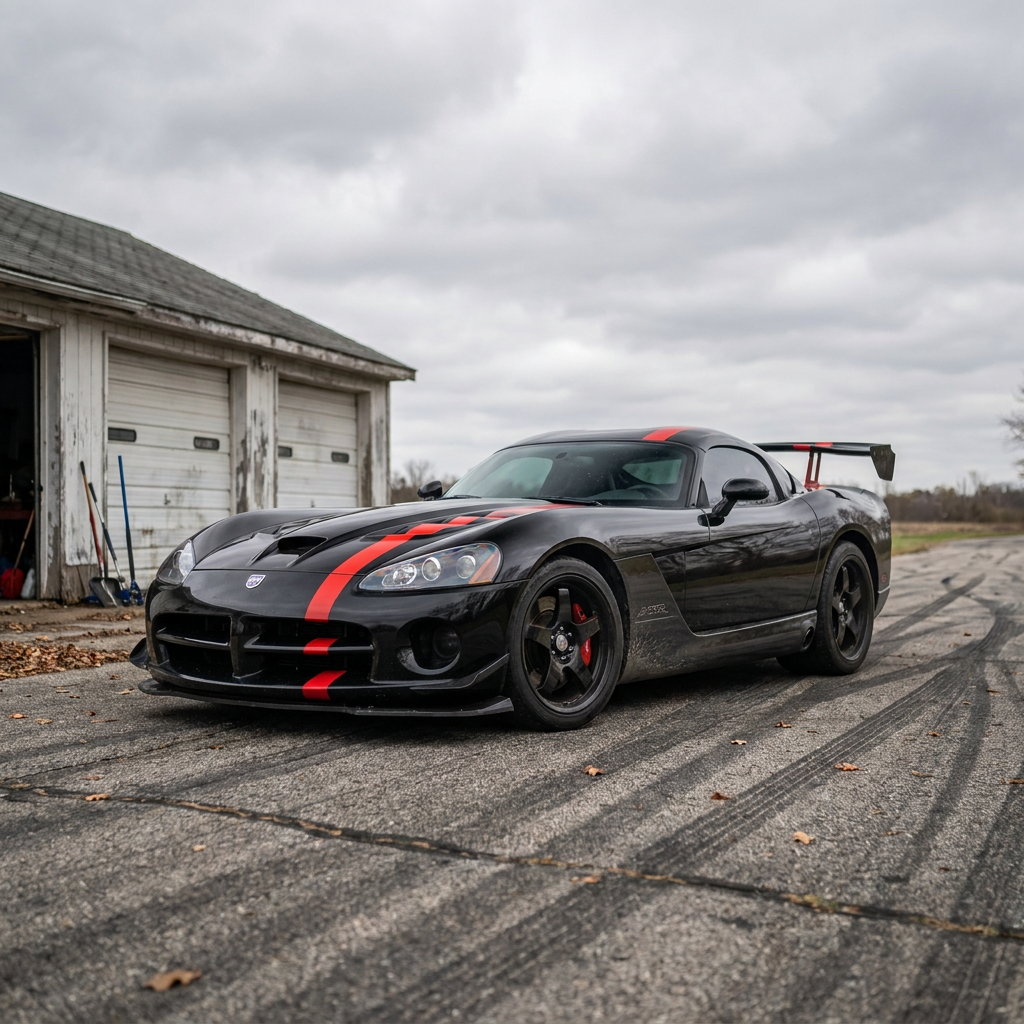
A pre-owned Dodge Viper for sale only makes sense with serious checks on title, use history, and mechanical condition—this car doesn’t forgive shortcuts.
When a pre-owned Dodge Viper for sale is truly worth a look
It makes sense for buyers who want an analog, powerful, demanding car—and accept that the purchase is only the beginning. The upside is an unfiltered driving experience. The trade-off is clear: costs and risks rise fast if the car was neglected or poorly modified.
Before chasing the lowest price, decide what you want the Viper to be: a collector piece, a weekend grand tourer, or a track base. That changes everything—what to inspect, which compromises are acceptable, and how much mileage or modification you can tolerate.
- Check the paperwork first: clean title, matching VIN, traceable maintenance.
- Read the car through consumables: tires, brakes, and clutch reveal real use.
- Be wary of the “deal”: a cheap Viper often shifts the bill to restoration and rare parts.
Many searches start with “Used Dodge Viper For Sale” or “Dodge Viper For Sale Used” and end on filter-heavy listings. Useful, but not enough. You need a method that reduces surprises—especially when the car is far away and the deal happens remotely.
Quick orientation: what you’re really buying
The Dodge Viper isn’t an “easy” modern sports car. In its best-known generations, the recipe stays similar: front-mounted V10, huge torque, rear-wheel drive, and a bare-bones cabin. It demands respect. Even at low speeds it can feel rough.
The used market tends to split into two worlds: original cars with clear history and careful owners, and cars with mods, track use, or cosmetic/mechanical fixes done to “sell well” in photos. The difference is in the boring details.
Three assumptions that often mislead buyers:
- “Low miles = perfect”: long storage dries seals, hardens tires, and ages fluids.
- “Mods = better”: some are sensible; many complicate diagnosis and insurability.
- “It’s just a simple American car”: some parts are specific and not always quick to source.
Another reality: the Viper was built in relatively limited volumes. That affects restoration time and cost, and makes the quality of the specific car you choose even more important.
Where to find a used Dodge Viper for sale—and how to filter the traps

For a used Viper, the typical sources are three: big marketplaces, specialty dealers, and private sellers. Each carries different risk. Marketplaces offer breadth and quick comparison, but also recycled ads and vague descriptions. Dealers can provide convenience and sometimes warranties, but they don’t replace an independent inspection. A private seller can be the most transparent—or the hardest to verify.
Before you even talk about a test drive, you need a document screen. A Viper with a problematic title or murky history becomes a project, not a purchase.
Red flags that deserve immediate attention in a “Pre Owned Dodge Viper For Sale” listing:
- Missing or partial VIN, or photos that don’t clearly show tags and identifiers.
- Few photos, all taken “from far away,” with no underbody, engine bay, or interior detail.
- Generic maintenance claims (“always serviced”) with no invoices or dates.
- A long mod list with no brands, no documented installation, and no coherent tuning.
A commonly overlooked filter is whether wear matches the claimed mileage. Steering wheel, driver’s seat, pedals, and shifter tell a lot. So do brake rotors. So do tires.
If the car is far away, the minimum ask is a guided set of photos and videos from the seller: cold start, instrument cluster, lights and indicators working, idle noises, and a pass under the car with decent lighting. No cinematography—just truth.
For basic checks on titles and safety notices, recall campaigns can be verified through official sources. In the U.S., the NHTSA recall database is a practical reference: NHTSA Recalls Database
Price, originality, and real use: what drives the value of a used Dodge Viper
The price of a used Dodge Viper isn’t just about model year. Generation, trim, color combo, originality, and documentation quality all matter. Less “showroom” factors count too—like consistent maintenance and whether original parts were kept.
A heavily modified car can cost less and look tempting. But moving away from stock has practical consequences: harder reliability estimates, more variability in tuning, and sometimes friction with insurance or local compliance. If you care about value retention, originality matters.
Some cost drivers are predictable:
- Track-oriented trims: suspension, aero, and brakes can raise value—and daily-use risk.
- Mileage: not just “how much,” but “how.” 20,000 highway miles isn’t the same as 5 track days.
- Owner history: frequent flips can signal unresolved issues or mismatched expectations.
Three useful numeric anchors, without getting into market prices that change monthly:
- 20,000 highway miles isn’t the same as 5 track days.
- Wide, expensive tires: on some setups, a set can be gone in a few thousand miles if driven hard.
- Brakes and clutch: if the car saw track time, wear can be much faster than weekend street use.
A “too good to be true” price often hides a non-straight title, undocumented repairs, or restoration needs. Not always—but often enough that it’s worth checking before any deposit.
At this stage you need discipline. The Viper is emotional. Mistakes are expensive.
Generations and trims: how driving feel, risk, and value change

Choosing a pre-owned Viper is often decided before you even see the photos. Generation matters. Trim matters. And intended use matters—because a “right” track Viper can become uncomfortable and costly as a Sunday car.
Different generations vary a lot in usability, refinement, and real-world “tolerance.” In general, older cars feel more mechanical and hotter, while newer ones are easier to live with. But they’re still Vipers—still physical.
Track-focused trims (ACR and similar) deserve a different read. More aggressive aero and stiffer setups raise capability and value for performance buyers, but also raise the odds of hard use. And they make it easier to hide a “hard life” behind a clean look.
A used Viper with light, documented mods can make sense. But “layered” builds are the time-wasters: non-stock ECUs, non-compliant exhausts, extreme suspension, or mismatched brake setups increase variability and reduce predictability.
| Scenario | Viper version | Why it changes the choice |
|---|---|---|
| Collecting and value retention | Near-stock example, complete history | Paperwork and consistency matter more than “listing accessories” |
| Weekend and street use | Road-oriented trim, manageable suspension | Less stiffness and noise reduce fatigue and indirect costs |
| Frequent track use | ACR or declared track setup | Higher performance, but expect faster wear and stricter inspections |
| Remote purchase | Car with a transparent owner and complete video proof | Reduces surprises on cold start, noises, and underbody condition |
When a search starts from “Dodge Viper For Sale Used,” the risk is confusing “the version you want” with “the version available.” If your goal is to drive it, an extreme trim can become a constraint. If your goal is track use, a too-street-focused car may require spending that erases any price advantage.
Viper PPI: a targeted checklist for what really costs money
A serious pre-purchase inspection on a Dodge Viper isn’t a formality. You want a tech used to high-performance cars and able to read track-use signs. A good PPI costs less than one wrong repair on the clutch, differential, or cooling system.
The checklist should follow a logic: structural integrity and traceability first, then mechanicals, then details that affect real use. A “normal car” inspection leaves gaps.
Items that deserve practical attention on a “Pre Owned Dodge Viper For Sale”:
- Underbody and jack points: scrapes, deformation, impact signs, or improper lifting. A low Viper doesn’t forgive much.
- Leaks and seepage: not just “is it leaking,” but where. Pan, transmission, differential, power steering, and radiators should be read together.
- Cooling and heat management: fans, radiator, hoses, reservoir, sweet smells, and residue. Heat is a constant, not a detail.
- Clutch and actuation: engagement point, slip in higher gears, vibrations. A “normally heavy” pedal shouldn’t hide a near-limit component.
- Brakes: pad thickness and rotor condition, plus heat discoloration and micro-cracks. Routine on track cars; a signal on “street” cars.
- Tires: age, inner wear, chewed shoulders, correct sizing. Old tires can look new—and change handling dangerously.
- Suspension and alignment: play, bushing wear, shock leaks, and visibly “crooked” stance. Extreme settings can indicate track use or accidents.
- Electronics and warning lights: scan for codes, not just the dash. Many issues stay quiet until they get expensive.
A commonly ignored detail: compatibility between modifications. Exhaust, intake, and tuning aren’t three separate line items. Without documentation on who did the work and how fueling was handled, the car can feel fast while living on the edge.
If the seller claims track use, the PPI should add one simple question: how many days, and what maintenance was done between them. It doesn’t need a perfect answer—just a coherent one.
Buying remotely: deposit, paperwork, and delivery without improvising
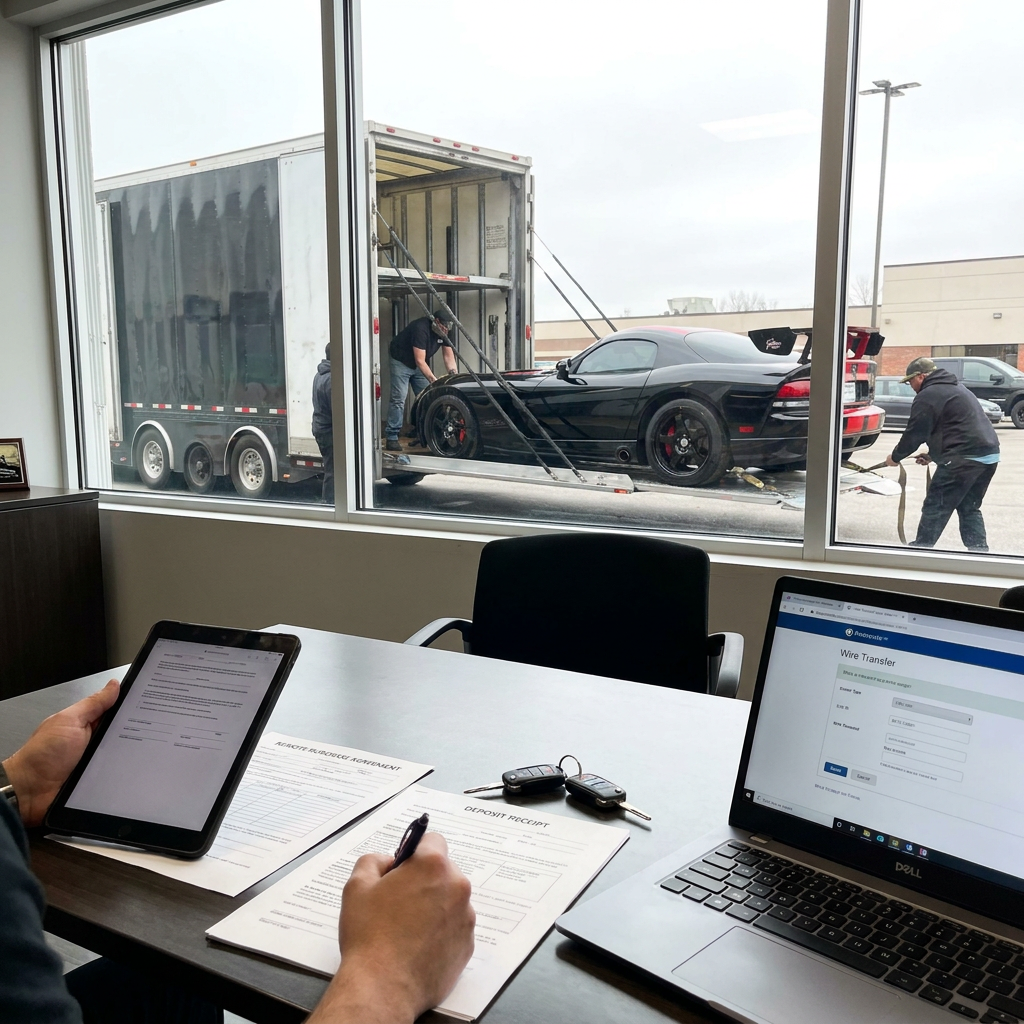
Many used Viper listings are far away—and the “right” car often isn’t local. A remote deal works only if every step reduces ambiguity, especially before money moves.
A deposit makes sense only after you’ve seen key documents and a coherent set of visual proof. High-resolution photos of tags, VIN, engine-bay labels, and body details are the minimum. Cold-start and instrument-function videos prevent arguments.
On the admin side, you need a clear sequence with defined timelines—not an endless chat.
- First: title copy, seller ID (or dealer registration), and maintenance invoices in chronological order.
- Then: an independent PPI booked and paid by the buyer, with a written report and photos.
- Only after: agreement on deposit and refund conditions if objective issues emerge (unclean title, structural damage, inconsistent mileage).
Delivery is its own chapter. A Viper in transport needs attention to ramps, ground clearance, and tie-down points. A carrier experienced with low sports cars reduces “logistics damage” that later becomes a blame game.
Timing and planning matter. A realistic remote purchase—PPI, paperwork, and transport—can take one to three weeks. Forcing it usually means skipping a check.
When the car crosses borders or changes states, local paperwork and checks come into play. For U.S. imports, a useful reference is U.S. Customs and Border Protection’s vehicle import page: CBP guide to importing a car into the United States
Ownership costs: consumables, insurance, and predictable maintenance
A pre-owned Viper can look like “just” a purchase—then ownership costs arrive. On a Viper, the difference between gentle use and aggressive use is huge, especially for consumables.
Realistic intervals depend on use, not just mileage. A car that’s driven little but gets hot and sits for long periods still needs fresh fluids and periodic checks. The goal is to avoid a cheap “storage period” turning into an expensive restart.
Three items that quickly change the economics:
- Tires: wide sizes and performance compounds can wear out in a few thousand miles if driven hard. Age matters as much as tread.
- Brakes: pads and rotors can become near-consumables with track use. On the street they last longer, but the car is heavy and fast.
- Clutch: city driving and stop-and-go abuse it; highway use is much easier. Use history predicts more than the odometer.
Insurance and claims handling aren’t uniform. A stock example with complete documentation and no invasive mods is usually easier to insure. A heavily modified car may require specialty coverage or exclude certain protections.
Storage matters too. A ventilated garage, battery tender, and periodic checks reduce electrical and battery issues. That’s not romance—it’s preventive maintenance.
If you’re looking for a “Dodge Viper For Sale Used” you’ll actually drive, the useful question isn’t “what does it cost to maintain” in the abstract. It’s whether your annual budget can absorb tires, brakes, and one unexpected repair in the same year. If the answer is “only the minimum,” the car needs to be close to perfect with an impeccable history—or frustration arrives quickly.
How to read a listing when you’re searching for a pre-owned Dodge Viper for sale
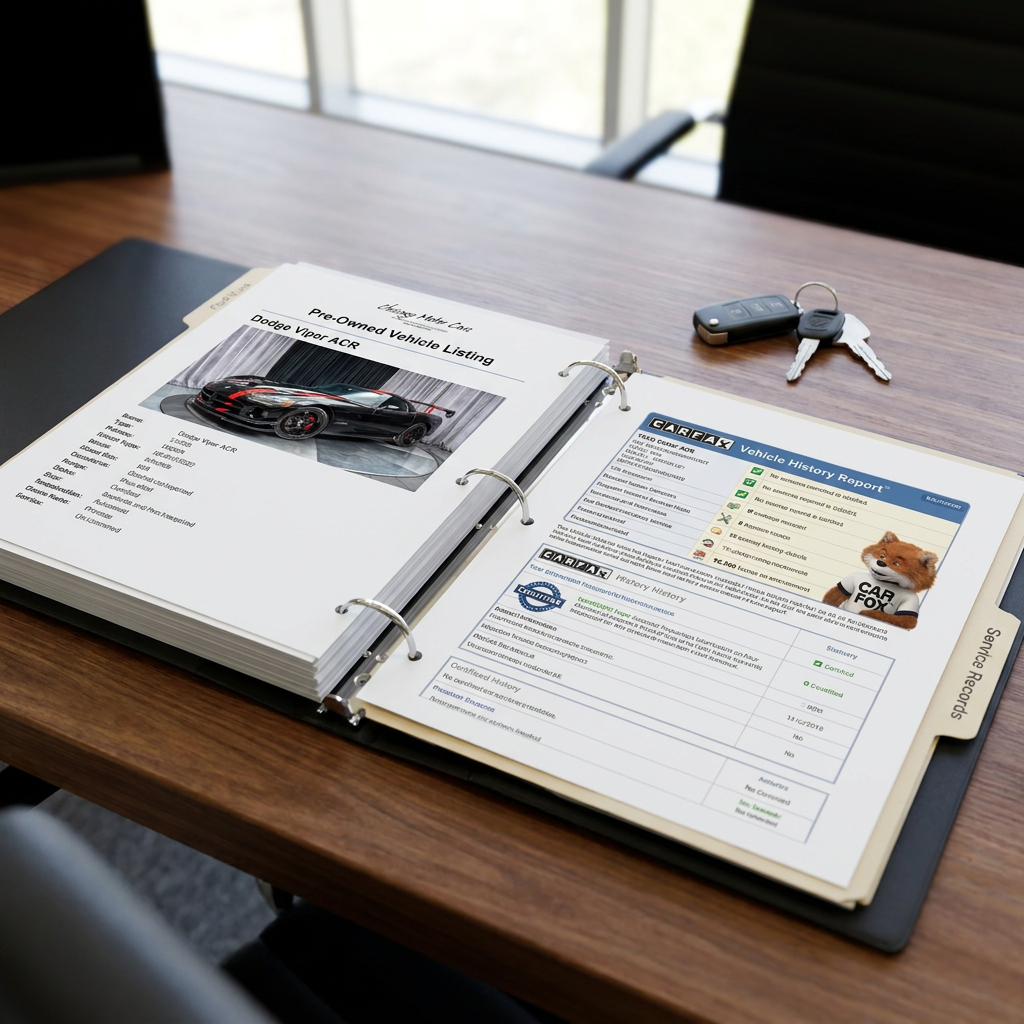
When your search lands on a “Pre Owned Dodge Viper For Sale” listing, quality shows more in the structure of proof than in the wording. A serious seller makes verification easy; an opaque one asks for trust.
A buyer’s read starts with three consistencies: documents, images, and narrative. If one doesn’t line up, the risk isn’t only financial—it’s wasted time, and on a Viper wasted time tends to become deferred maintenance.
Details that raise the odds of a smooth deal:
- Complete photo sequence: exterior in natural light, interior, engine bay, ID tags, underbody. Photos should be plentiful and repeatable, not “three good shots.”
- Maintenance told with dates: no novel needed—just a timeline. Even a few coherent invoices beat “always serviced.”
- Transparency on modifications: component brands, who installed them, and whether original parts are included. A context-free list is just risk dressed up as accessories.
- Verifiable answers: simple questions (cold start, warning lights, last fluid change) should be backed by video or proof—not “trust me.”
A listing can be poorly written and still hide a good car. But a listing full of superlatives and short on proof rarely turns into a pleasant surprise.
A clear editorial stance: between two similar cars, the one with better documentation and transparency almost always wins—even if it costs more. You often earn that difference back in the first year.
Who it truly fits—and who it may wear out
A used Dodge Viper makes sense for someone who wants a car to drive with respect and method—regular outings, maybe a few events—and accepts that a serious inspection matters more than a rare color. You need willingness to manage garage storage, preventive maintenance, and a physical driving experience. It works best when the goal is informed ownership, not a quick flip.
It’s a poor fit for anyone who wants daily practicality, dislikes noise and heat, or expects a “no worries” car. And anyone chasing a bargain on a “Dodge Viper For Sale Used” without verification risks turning the purchase into a long project. If your budget only covers the entry price, the experience becomes fragile.
Common questions
Does “Pre Owned Dodge Viper For Sale” always mean the car is verified and reliable?
No. It’s just a listing label and can mean different things depending on the seller. Reliability and quality come from a clean title, traceable maintenance, and an independent inspection.
Is it better to buy a stock example or a modified Viper?
For value retention and predictability, stock is the simplest path. Light, documented mods can make sense, but layered work without proof makes risks and costs harder to estimate.
How much does the number of owners matter on a used Dodge Viper?
History consistency matters more than the number itself. Many owners in a short time can signal unresolved issues or mismatched expectations, while a long, documented history tends to reduce surprises.
Is a far-away “Used Dodge Viper For Sale” worth it, or too risky?
It can be worth it if the deal is built on proof: documents first, targeted videos, an independent PPI, and transport handled by carriers used to low sports cars. Without that discipline, distance amplifies every ambiguity.
When is a low price a real opportunity, and when is it a warning sign?
A below-market price can be legitimate, but it needs a verifiable explanation (high mileage, cosmetic work needed, fast sale timeline). If the explanation stays vague or changes, it’s smarter to treat it as a warning, not an advantage.
Verdict and use case

A pre-owned Dodge Viper for sale is a smart choice when you treat it as selecting a specific example—not hunting a model. The real value is in history quality and predictability, not the promise of the listing.
A concrete scenario where it works: a weekend car driven regularly, garage-kept, and maintained methodically, with the goal of driving often without turning every season into a restoration list. In that context, paying more for transparency and condition becomes a form of savings, not a whim.